

The Avatar in a Wheelchair: A Call for More Diversity in the Metaverse
December 1, 2025;
Christina Warren
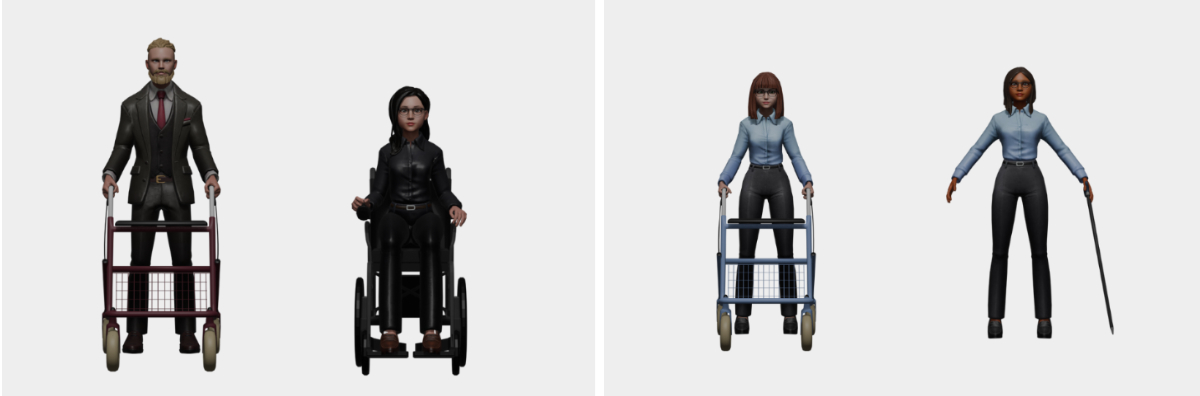
Virtual environments are inclusive because all users can choose avatars that allow them to leave
their disabilities behind in the real world – right? For a long time, this was the stance both
users and developers took on the metaverse. Now, a new study by researchers from the
University of Stuttgart,
the
California State University at
Fullerton, and the
Max Planck Institute for Intelligent
Systems investigated how users with disabilities feel when their avatar reflects their
real-life disability.
The results: While some users with disabilities prefer to navigate virtual environments
without their avatar representing their disability, many gave very positive feedback on their
experiences with using an avatar that depicts them the way they see themselves. Together with the
fact that the inclusive avatars frequently sparked interest in other users whom the study
participants encountered in the metaverse and led to open conversations, the authors of the study
take this as encouragement to call for more diversity in the metaverse.
"We hope that the results of the study will provide the impetus to actively involve people
with disabilities in the development and design of virtual reality technology, and to work together
to break down structures of discrimination in virtual space. A disability should not be something
that needs to be hidden, but something that can be lived openly in virtual space as well. People
with disabilities belong in both the real and digital world," says
Katrin
Angerbauer, doctoral student in SFB-TRR 161
Project A08 and first
author of the study.
The results of the study were published in The Journal of Strategic Information Systems,
doi: 10.1016/j.jsis.2025.101935
Full
press release published by MPI-IS
News and Press
Looking for an Expert?
The Project Leaders of the SFB-TRR 161 are experts in the field of visual computing. You are welcome to get in touch directly.
If you need help finding the right contact for your inquiry, please contact the Public Relations Team.
BOGY in der Forschung?
Du möchtest schon während der Schulzeit die Welt der Forschung kennenlernen? Du möchtest dich über die Studiengänge an unseren Transregio Partnern informieren? Du programmierst gerne oder interessierst dich für Informatik und Computergrafik?
Ein BOGY im SFB-TRR 161 gibt dir die Chance, dich mit unseren Forschern auszutauschen und in die Arbeitswelt der Wissenschaft einzutauchen.
FOR SCIENTISTS
Projects
People
Publications
Graduate School
Equal Opportunity
FOR PUPILS
PRESS AND MEDIA
SOCIAL MEDIA


© SFB-TRR 161 | Quantitative Methods for Visual Computing | 2019.